Tell us about the job
Takes about a minute. No obligation.
A furnace repair in Hoonah-Angoon starts with the parts that have been working hardest: the burner, the heat exchanger, and the ignition system. Homes in Hoonah-Angoon Census Area, AK run heat in every month of the year. With no real idle period, those components cycle through their wear without a rest season to slow the accumulation. A contractor quoting a repair here checks the ignition assembly and the heat exchanger carefully before moving on, because those are the parts most likely to show what months of continuous load actually produce.
Furnaces in houses like these have often outlasted the original equipment by a generation, but the ductwork and the heat exchanger tell a different story. Half the homes in Hoonah-Angoon Census Area, Alaska were built in 1984 or earlier (2020-2024 ACS 5-year). That means a contractor opening a furnace here is working inside a system that has cycled through Alaska winters long enough to show it: cracked heat exchangers, sealed-over dampers, and ducts that have shifted with the house. Parts availability for older furnace models in a remote census area is a real constraint, and what the opened unit turns out to need drives the repair scope more than anything visible from the outside.
The Parts of a Furnace a Contractor Checks First
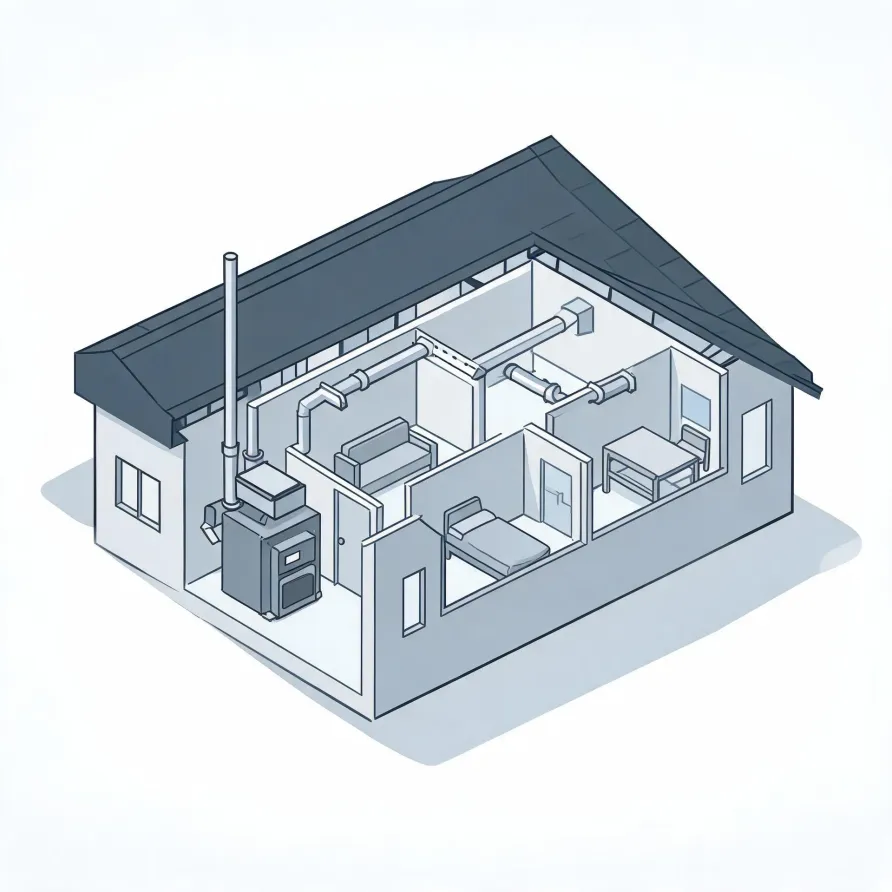
The heat exchanger sits at the core of the furnace cabinet and is the piece a contractor looks at closely during a repair call. Cracks or buildup there affect the whole system. The burner assembly fires just below it, and a fault at the burner is often where a no-heat complaint begins.
The blower motor and its fan wheel sit in the lower section of the cabinet and push conditioned air into the supply side of the house. The inducer motor pulls combustion gases out through the flue. The control board ties all of it together, and a contractor reads its fault codes early to narrow down which piece has failed.
The drawing shows the general layout of a furnace system, and a licensed contractor determines what applies to the specific equipment and configuration in your home.
Find a contractor in Hoonah-Angoon Census AreaHoonah-Angoon Census Area by the Numbers
31 severe weather events were recorded in Hoonah-Angoon Census Area, Alaska between 2015 and 2024.
NOAA National Centers for Environmental Information, Storm Events Database, bulk CSV export, events 2015-01-01 through 2024-12-31.Half the homes in Hoonah-Angoon Census Area, Alaska were built in 1984 or earlier (2020-2024 ACS 5-year).
U.S. Census Bureau, 2020-2024 American Community Survey 5-Year EstimatesHoonah-Angoon Census Area, Alaska holds 1,753 housing units (2020-2024 ACS 5-year).
U.S. Census Bureau, 2020-2024 American Community Survey 5-Year EstimatesOwners occupy 72.0% of the occupied homes in Hoonah-Angoon Census Area, Alaska (2020-2024 ACS 5-year).
U.S. Census Bureau, 2020-2024 American Community Survey 5-Year EstimatesCodes & Standards Behind Furnace Repair in Hoonah-Angoon Census Area, Alaska5 sourced rules and standards
What HVAC Repair Looks Like Out Here
Non-weatherized gas furnaces manufactured on or after November 19, 2015 must reach 80.0 percent AFUE.
Non-weatherized oil-fired furnaces manufactured on or after November 19, 2015 must reach 83.0 percent AFUE.
Mobile home gas furnaces manufactured on or after November 19, 2015 must reach 80.0 percent AFUE.
Non-weatherized gas furnaces manufactured on or after December 18, 2028 must reach 95.0 percent AFUE, up from the 80.0 percent minimum that applies to units manufactured before that date.
Licensing Rules for HVAC Repair in Hoonah-Angoon Census Area, Alaska
Alaska requires a certificate of registration as a contractor: a person may not submit a bid or work as a contractor until the department has issued one.