
Why your furnace won't turn on in an Alaska winter
Why won't my furnace turn on in this cold?
Thirty below outside and the house is going cold. You've checked the thermostat, flipped the breaker, and the furnace still won't fire. In an Alaska winter this isn't something to wait out. With power rates as high as they are here, you also don't want to run space heaters all night while you figure out what's wrong.
Most often it's the igniter or a safety switch shutting the furnace down
Gas furnaces have a hot surface igniter that wears out over time, and once it can't get hot enough to light the burners, the furnace won't start at all. The other common cause is a safety switch tripping, often from a clogged filter or a blocked vent, which cuts the furnace off before it can overheat or push exhaust back into the house. Extreme cold makes both worse. A furnace that struggles to light on a mild day may fail outright when it's thirty or forty below, because the igniter has less margin and the vent is more likely to frost over. Either way, the furnace isn't being stubborn. It's shutting itself down on purpose.


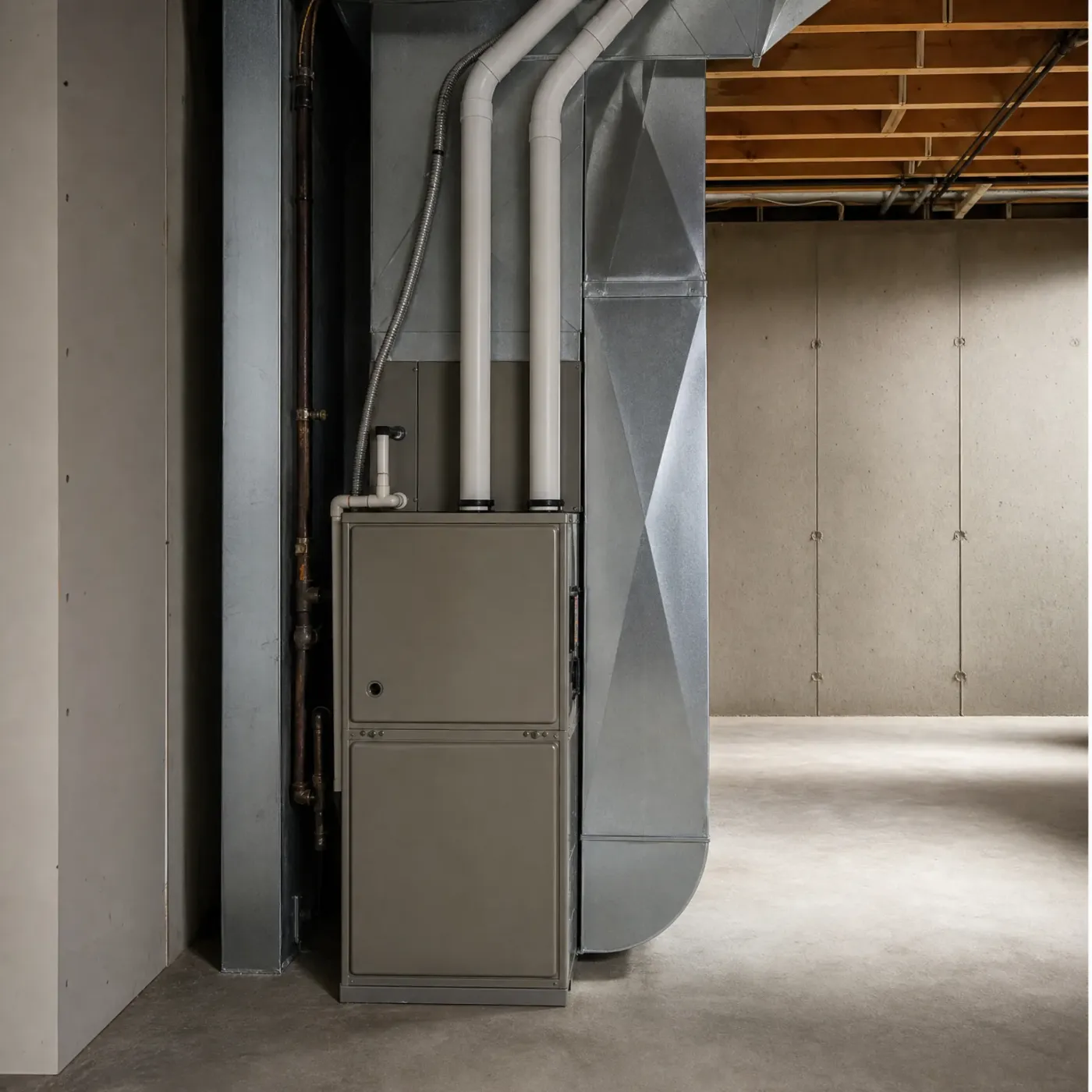
A furnace that won't start is usually failing one check in a short sequence, not breaking down all at once. First the inducer motor has to run and prove it's pulling exhaust air out. The control board watches for that before it does anything else. If the vent pipe outside has frosted over or packed with snow, the inducer can't prove draft and the sequence stops right there, before the igniter ever gets power. If draft does prove, the igniter has to climb to full heat, and a circuit already strained by deep cold can leave it short of that mark. Once it fires, the flame sensor has only a few seconds to confirm a flame or the board closes the gas valve again, treating it as a fault. High-efficiency furnaces add another stop: the condensate line that drains outside can freeze solid and trip a float switch that holds the burner off entirely. And if the thermostat's wiring or batteries have given out in the cold, none of this starts, because the furnace never gets the call for heat.
What's Actually Stopping Ignition
- A gas furnace won't fire if the igniter can't reach full temperature, and deep cold draws down the same circuit your blower and controls run on.
- The flame sensor has to see a flame within a few seconds of ignition or the control board shuts the gas valve as a safety check.
- The inducer motor has to prove it's pulling exhaust before the control board ever sends power to the igniter.
- Furnaces vent through a pipe to the outside, and that pipe can frost shut or clog with snow after a storm, which blocks the inducer from proving draft.
- A thermostat reading room temperature correctly can still fail to call for heat if its wiring or batteries have failed in the cold.
- Condensate lines on high-efficiency furnaces drain outside or through unheated space, and that water freezes solid and trips a float switch that stops the burner.






A pro who works on furnaces
A furnace that won't fire at thirty below isn't a problem to leave for the weekend. Once the house starts losing heat, pipes are at risk right along with your comfort, and every hour on a space heater adds to a power bill that's already steep. Figuring out whether it's the igniter, the pressure switch, or something drawing down that circuit means someone has to open the unit up and test it, and that's not a safe guess to make yourself in a cold snap. Finding that person usually means searching around, calling a few numbers, explaining the same thing more than once, then waiting to see who calls back first. Right now your time is better spent keeping the house warm than running down contractors. Put in your address and what's going on with your furnace, and let a contractor who works on these in Alaska winters take it from there.

Cold air feeds the flame
A gas furnace draws combustion air from outside or from a vent that runs to the outdoors. That intake has a screen or a hood on it, and in a hard freeze, frost can seal it shut in a few hours. No air in means no flame, and the control board won't open the gas valve without it. Ice on that hood is one of the first things worth a look before anything else.

Why the blower still runs
Some furnaces will push air through the ducts with the blower motor even after the burner has failed to light, because the blower and the burner are on separate controls. That's why a house can have cold air coming out of the vents instead of none at all. It feels like the furnace is working and failing at the same time, and in a way it is. The ignition side and the air side are two different jobs.
Winter nights average 9°F statewide
A night that averages 9 below zero means your furnace is running nearly nonstop to hold the house at temperature. It cycles on more, the igniter and blower see more wear, and a weak part fails sooner than it would somewhere milder.
NOAA nClimDiv 1991-2020 county normals weighted by homes
One part, one cause, one fix
- A furnace that won't fire at thirty below usually comes down to one blocked vent, one weak igniter, or one safety switch doing its job.
- The cold doesn't create new problems so much as it finds the one part that was already close to failing.
- Checking the thermostat and breaker rules out the easy causes, but it doesn't tell you which part inside the furnace quit.
- Finding a contractor who can get to you fast, explaining the problem over and over, and sorting through quotes all take time you don't have when the house is dropping toward freezing.
- A furnace stuck in a failed state will keep cycling or stay dark no matter how many times you reset it.
- Matching with a contractor who knows cold-weather furnaces skips the calling around and gets someone looking at the actual part that failed.
A furnace that won't fire at thirty below has a reason, and it's almost always one thing. A frosted intake, an igniter that can't get hot enough, a flame sensor that doesn't see fire fast enough, a safety switch doing exactly what it's built to do. The cold didn't break your furnace. It just put enough strain on the system that whichever part was already worn gave out first. That's why the thermostat and the breaker check out fine. The problem isn't upstream of the furnace, it's inside it, and no amount of resetting changes that.
Once you know that, the work left isn't figuring out more about the furnace. It's finding someone who can get to your house and work on it, tonight if the house is already dropping toward freezing. That usually means calling a handful of contractors, telling each one the same story about the breaker and the thermostat and the thirty below outside, waiting to hear who can actually come out in this weather, then comparing whatever quotes come back while the house keeps losing heat. None of that gets the furnace running. It just delays the part where someone looks at the igniter or the flame sensor or the vent and tells you which one it is.
Getting matched with a contractor who already works on cold-weather furnaces skips that part. You explain it once, to someone who shows up knowing what thirty below does to a furnace, and the rest is between you and them.
Get your furnace to the right pro
Explain the job once and skip repeating it on every call.
You only hire the pro if you want to.