Tell us about the job
Takes about a minute. No obligation.
A furnace in Bethel Census Area fires through every month on the calendar. Homes in Bethel Census Area, AK run heat in every month of the year. The burner, heat exchanger, and ignition system never get a long idle stretch where wear stops accumulating. When a component fails, a contractor has to determine how much of that failure traces to sheer runtime versus a manufacturing fault or an installation problem, because the answer changes what gets replaced and what gets left alone. A cracked heat exchanger on a relatively young unit, for instance, points somewhere different than the same crack on one that has been cycling without pause for years.
Furnace parts availability follows the age of what was originally installed, and a house built when much of Bethel Census Area's stock was new is likely to be running equipment whose parts catalog has thinned considerably. Half the homes in Bethel Census Area, Alaska were built in 1988 or earlier (2020-2024 ACS 5-year). A contractor who opens a furnace in a home from that era may find that the component needing replacement has been superseded twice, with aftermarket substitutes that fit differently or carry different ratings. That gap between what the unit takes and what distributors stock is where repair costs move, and where a contractor has to decide whether a sourced part or a full replacement is the practical path forward.
The Parts of a Furnace a Contractor Checks First
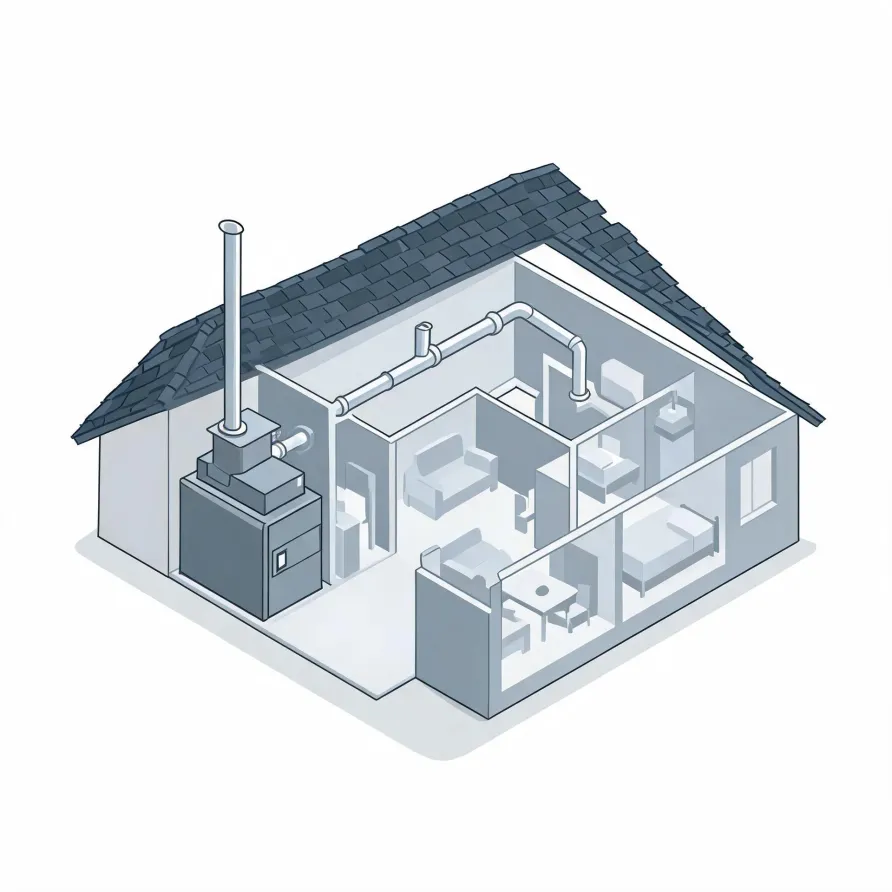
The furnace cabinet sits in a utility room, basement, or crawlspace and is where heat is actually made. Inside it, the heat exchanger is the part a contractor looks at early: cracks or corrosion there let combustion gases into the airstream. The burners and the igniter sit just below it, and a failed igniter is one of the more common reasons a furnace stops producing heat at all.
The blower motor lives at the base of the cabinet and pushes conditioned air out through the supply side of the house. Alongside it, the control board reads signals from the thermostat and tells every other component when to act. When a furnace behaves oddly, cycles short, or shows an error code, the control board and the blower are both on the contractor's early checklist.
The drawing shows a typical furnace layout, and a licensed contractor determines which components apply to your specific system and what condition each one is in.
Find a contractor in Bethel Census AreaBethel Census Area by the numbers
Half the homes in Bethel Census Area, Alaska were built in 1988 or earlier (2020-2024 ACS 5-year).
U.S. Census Bureau, 2020-2024 American Community Survey 5-Year EstimatesBethel Census Area, Alaska holds 6,011 housing units (2020-2024 ACS 5-year).
U.S. Census Bureau, 2020-2024 American Community Survey 5-Year EstimatesOwners occupy 61.6% of the occupied homes in Bethel Census Area, Alaska (2020-2024 ACS 5-year).
U.S. Census Bureau, 2020-2024 American Community Survey 5-Year EstimatesCodes & Standards Behind Furnace Repair in Bethel Census Area, Alaska5 sourced rules and standards
What HVAC Repair Looks Like in Bethel Census Area
Non-weatherized gas furnaces manufactured on or after November 19, 2015 must reach 80.0 percent AFUE.
Non-weatherized oil-fired furnaces manufactured on or after November 19, 2015 must reach 83.0 percent AFUE.
Mobile home gas furnaces manufactured on or after November 19, 2015 must reach 80.0 percent AFUE.
Non-weatherized gas furnaces manufactured on or after December 18, 2028 must reach 95.0 percent AFUE, up from the 80.0 percent minimum that applies to units manufactured before that date.
Licensing Rules for HVAC Repair in Bethel Census Area, Alaska
Alaska requires a certificate of registration as a contractor: a person may not submit a bid or work as a contractor until the department has issued one.